

City Hall

Location: Located at 144 Tichenor Avenue, Auburn, Alabama
Marker Dedication or Erection Date: September 17, 2002
SIDE 1: CITY HALL
In 1846, Auburn’s Founder, Judge John J. Harper deeded the property on this corner to Simeon Perry, as town agent for two of the earliest public schools in Auburn. A member of the settlement party, Perry laid out the original boundaries of the City of Auburn. In 1931, the City of Auburn donated this land for a larger post office. Congress gave $90,000 for its construction and the building was completed in 1933, while Levi Knapp was Postmaster. First class status was attained here in 1940 under Postmaster Homer Wright, and it served as the post office until 1991. It was at least the seventh location for town postal service.
Erected by the Historic Chattahoochee Commission, the City of Auburn and the Auburn Heritage Association, 2002

SIDE 2: CITY HALL
The City of Auburn bought the building in 1992 for $375,000. In 1999, the City Council voted to renovate it as City Hall. It was dedicated in 2001. The building has a “Starved-Classical,” symmetrical style, with pointed pediments, typical of Federal Depression architecture. These elements have been preserved through several additions and renovations. Postmasters who served Auburn on this site: Levi A. Knapp; Homer Wright; Mrs. Katherine Wright; Jay G. Hitchcock; Harold Nall; Charles M. Dawson; Bill Kitchen; J. Dan McLaughlin. The building was listed on the National Register of Historic Places by the U.S. Department of the Interior in 1983.
Erected by the Historic Chattahoochee Commission, the City of Auburn and the Auburn Heritage Association, 2002
Baptist Hill

Marker Dedication or Erection Date: March 5, 1995
SIDE 1: BAPTIST HILL
Auburn’s first separate black community cemetery offers a rich source of the city’s black heritage. Much of the history is oral but it is known that a white man gave most of the land in the early 1870’s. The four-acre, cemetery contains over 500 marked graves and many others are unmarked. The oldest grave is dated 1879. Those interred here are a cross-section of the city’s blacks. Many were born slaves but later succeeded in teaching or business. The cemetery is still in use and is maintained by the City of Auburn but its ownership is unknown. Documentation of the site was done by the auburn Heritage Association in 1990.
Erected by the Historic Chattahoochee Commission and the Auburn Heritage Association, 1994.

SIDE 2: BAPTIST HILL
Though located at the base of a slope, the cemetery derives its name from Ebenezer Baptist Church on a hill to the west. Ebenezer, established in 1865, was the first black churched formed in Auburn after the Civil War. The church building was erected before 1870 on land donated by Lonnie Payne, a white man. The church was so prominent in the area that it gave the name “Baptist Hill” to the vicinity. Its members were the first buried in the cemetery although members of other black churches are now interred here. Ebenezer was placed on the National Register of Historic Places in 1978. The cemetery was added to the Alabama Register in 1994.
Erected by the Historic Chattahoochee Commission and the Auburn Heritage Association, 1994.
The Crescent

The Crescent was an exclusive train of Southern Railway (SR) and Alabama affiliates, Western Railway of Alabama (WRA), Atlanta & West Point Railway (AWPR), and Louisville & Nashville Railway (LNR). Excepting SR, these lines provided passenger service to Auburn and its college. In 1925, these trains, collectively named the Crescent Limited, ran between Washington, DC, and New Orleans. SR covered Washington to Atlanta, AWPR and WRA served Atlanta to Montgomery and LNR ran from Montgomery to New Orleans. These locomotives hauled 12 to 15 passenger cars, about 700–1000 tons, at 80 mph, with averages of 50 to 60 mph. Engines used 14,000 gallons of water during the 150 miles between stops while 16 tons of coal fueled the distance.
Erected by the Auburn Heritage Association and the Historic Chattahoochee Commission 2016

The Atlanta & West Point Railway engine, No. 290, a 4-6-2 heavy Pacific engine that traveled from Atlanta to Montgomery, is housed in the Southeastern Railway Museum in Duluth, GA. Its Southern Railway sister engine, No. 1401, is in the Smithsonian. In 1938 the train was renamed the Crescent and remained so for 40 years. By 1941, steam engines were no longer the power for the flagship train, being replaced by diesel engines. The last AWP/WRA trains stopped in Auburn in January, 1970. By then all of the luxurious features of the Crescent had been discontinued for lack of patrons, with the rail line only using day coaches.
Erected by the Auburn Heritage Association and the Historic Chattahoochee Commission 2016
THE AUBURN GUARDS REVIEWED BY JEFFERSON DAVIS

At the Auburn train depot on February 16th, 1861, Jefferson Davis reviewed the Auburn Guards, the first Confederate military company thus honored. Davis was en route to his inauguration
as President of the Confederacy. The Auburn Guards were comprised of cadets of the East Alabama Male College (now Auburn University). Forty-two members of the Guards went by rail from Montgomery to Pensacola on January 16th, 1861, under orders from Alabama Governor Moore, to fortify the fort there. The officers of the Auburn Guards were as follows:
George W. Dixon, Captain; Wm. F. Stanton, 1st Lieutenant; F. G. McElhany, 2nd Lieutenant;
J. H. Echols, 3rd Lieutenant.
Sponsored by Historic Chattahoochee Commission,
the Auburn Heritage Association,
SCV Robert E. Lee Camp #16, UDC Auburn Guards Chapter #2677
2011
Scott Yarbrough House

Location: Located at 101 Debardeleben Street, Auburn, Alabama
Marker Dedication or Erection Date: December 10, 1978
SIDE 1: SCOTT-YARBROUGH HOUSE
Home of Nathaniel J. Scott Family 1847-1871. Colonel Nathaniel J. Scott, from Harris County, Georgia, and brother-in-law of John J. Harper (1807-1863), founder of Auburn, Alabama, built this house, which he called “Pebble Hill,” on 100 acres at this site in 1847. With its pyramidal roof and symmetrical lines, the frame house reflects the Greek Revival architecture popular at the time. Colonel Scott was one of four commissioners appointed to lay out and manage the town of Auburn. He organized the East Alabama Masonic Female College in 1847. In 1856, he led the establishment of East Alabama Male College, now Auburn University. Colonel Scott was Auburn’s first State Legislator.

SIDE 2: SCOTT-YARBROUGH HOUSE
Owned by the Dr. Cecil Yarbrough Family, 1912-1974. “Pebble Hill” was purchased in 1912 by Dr. Cecil S. Yarbrough (1878 -1940) for his family home. Dr. Yarbrough served in the Alabama State Legislature in the 1920s. He served three times as Mayor of Auburn, in 1918, in 1921-22, and from 1936-44. He was a college physician during World War II. The Auburn Heritage Association purchased the House in 1974. The raised cottage rests on a brick foundation. The joists and rafters are pegged. The floors are hand-hewn heart pine. Owners between 1871-1912: Ray, Hollifield, Riley, Hodges.
Erected by the Historic Chattahoochee Commission, 1978.

Sani-Freeze Dairy Bar
In 1939 C. R. “Red” and Luckie Meagher built by hand and opened “The Doll House”, a sit-down restaurant near this site on Glenn Avenue selling sandwiches, sodas, and fresh apple pies. The name came from dolls that decorated shelves along the ceiling. In the early 1940's "The Doll House" was rented to Archie McKee. In 1960 it was sold again to Bennie and Ethel Hunt who renamed it "Sani-Freeze"; a popular walk up and order dairy bar for Auburn citizens, students, and alumni. Students affectionately nicknamed it “The Sani-Flush” (as an “homage” to the commercial toilet bowl cleaner of the day), or, more simply, “The Flush”. The original 50+ year old decaying building was demolished in 1993. "Sani-Freeze" continued as an Auburn institution selling ice cream cones, banana splits, and sundaes at another location until 2000.
War Eagle!
Erected by the Auburn Heritage Association
2019
LUCKIE MEAGHER’s KINDERGARTEN
Mrs. Luckie Meagher established a private kindergarten just east of this site and served as its premier teacher for more than 30 years, caring for delicate young minds from both Auburn and Lee County. Red Meagher even built small chairs for Luckie’s pupils. In the late 1940’s Mrs. Meagher began to notice some of her pupils had difficulty learning to speak phonetically and a few were unable to hear. She consulted with Dr. Frank Davis, an API speech professor in the English Department. As a result, Dr. Davis hired a specialist for the hearing impaired, who began the Speech and Hearing Clinic at API (Auburn University). Owing to its concern for children, a local chapter of the Pilot Club provided energies, inspiration and financial support.
Erected by the Auburn Heritage Association
2019
Auburn University Chapel

Marker Dedication or Erection Date: May 7, 1995
SIDE 1: AUBURN UNIVERSITY CHAPEL
The University Chapel is the oldest public building in the city of Auburn. Built as a Presbyterian Church, the first service was held in the original Greek Revival-style building on September 13, 1851. Edwin Reese, spiritual leader of the tiny congregation, had the bricks made by slaves on his plantation. The founder of the town, Judge John J. Harper, gave the land. The first minister was the Reverend Albert Shotwell. The small church has seen several renovations over the years and has dramatically changed in appearance from Greek Revival to Gothic style. Originally, the church had two entrances, one for men and one for women. The church building has served many purposes and played an integral part in the town’s history. In the 19th Century, it was used as a Confederate hospital, a meeting place for the first Episcopal congregation, and in 1887, when the main building burned at Alabama Polytechnic Institute, the college used the building for a temporary classroom. By 1917, the Presbyterian congregation with over 100 members, moved to their new building on the corner of Gay and Thach. It was placed on the National Register of Historic Places by the Department of the Interior, National Park Service, May 22, 1973.
Erected by the Historic Chattahoochee Commission and the Auburn Heritage Association, 1994.

SIDE 2: AUBURN UNIVERSITY CHAPEL
In 1921, the Alabama Polytechnic Institute acquired the building, which had been renovated in a Gothic style around 1900. Until 1926, it served a variety of social functions, housing the U.S.O. and later the Y.M.C.A. - Y.W.C.A., giving it the long-time sobriquet the “Y” Hut. On July 27, 1926, the Auburn Players made their debut performance, and until 1973, it was the University Theatre. In 1976, after extensive renovation designed by Professor Nicholas Davis, the old church reopened as the University Chapel, an interdenominational, multipurpose building. During renovation, the hand-made trusses, girders, and joists, slotted and pegged together, were discovered. The new ceiling was built above this wooden network to highlight this original feature. The new entrance doors are replicas of the originals, as is the steeple. The beautiful old bricks were cleaned, repaired, and a new layer of mortar was put into the joints. Landscaped walkways and curving brick walls were all added. Funds for the project were given by the E. L. Spencer, Jr. family. It stands today as a blend of the old and the new, a reminder of Auburn’s religious, academic, and social history.
Erected by the Historic Chattahoochee Commission and the Auburn Heritage Association, 1994.

Dillard-Lawson House
Marker Dedication or Erection Date: 2000
Marker Text:
Built by Auburn merchant A. L. Dillard in 1894, the home was once part of the old Scott Plantation. It was one of the first homes in Auburn to have an indoor bath and electricity. An unusual feature of the house is the gray stone, for which Dillard invented a secret formula to make it moisture proof. Mrs. Dillard and her daughter were the first registered women voters in Lee County. In 1925, Sigma Pi Fraternity was chartered here. The James L. Lawson family owned the house from 1939-1984. It was home to Mabel Yearby, the first woman defense lawyer in Alabama. In 1984 the house was sold to business interests.
Erected by the Auburn Heritage Association and the Historic Chattahoochee Commission, 2000.

Ebenezer Baptist Church / Baptist Hill / East Thach Avenue
Location: Located at the Church on East Thach Avenue, Auburn, Alabama.
Marker Dedication or Erection Date: December 10, 1978
SIDE 1: EBENEZER BAPTIST CHURCH / BAPTIST HILL / EAST THACH AVENUE
This simple frame structure was built by newly freed black men and women before 1870. The property on which the building stands was given to a member of the Ebenezer congregation in 1865, the year the War Between the States ended, by a white landowner, Lonnie Payne. The church is built of hand hewn logs, felled on the Frazer plantation, northeast of Auburn, and were hauled by mule to this site. Members of the congregation constructed the building. The Church and its early leaders figured prominently in Alabama’s black Baptist history. The church congregation held its services here until 1969.

Ebenezer Baptist Church / Baptist Hill / East Thach Avenue
SIDE 2: EBENEZER BAPTIST CHURCH / BAPTIST HILL / EAST THACH AVENUE
Pastors serving church at this site: Reverend Tom Glynn Reverend Ishman Pollard Reverend I. T. Simpson Reverend C. J. Davis Reverend H. E. Jones Reverend Saunders Reverend O.D. Slaughter Reverend J. M. Alexander Reverend G. R. Young, Jr.
Erected by the Historic Chattahoochee Commission, 1978

General James Henry Lane House/Woman’s Club of Auburn

General James Henry Lane House/Woman’s Club of Auburn
Location: Located at the corner of Thach & College Street, Auburn, Alabama.
Marker Dedication or Erection Date: October 8, 1992
Marker Text:
General James Henry Lane House/Woman’s Club of AuburnThe Lane House, built in 1853 at the corner of Thach and College Street, was home to several Auburn University notables. E. T. Glenn, Treasurer, leased it in 1873. General James H. Lane, Aide to General Stonewall Jackson and Head of Engineering, purchased the house in 1884. Daughter Mary married Dean George Petrie, author of the Auburn Creed. Daughter Kate Meade Lane was the last resident. Mollie Hollifield Jones purchased the house in 1960 for the Woman’s Club. The house was moved to its present location in 1962. It was placed on the Alabama Register of Landmarks and Heritage in 1991.
Erected by the Historic Chattahoochee Commission and the Women’s Club of Auburn, 1992.
.jpg/:/cr=t:0.85%25,l:0%25,w:100%25,h:98.29%25/rs=w:600,h:300,cg:true)
Lee County Courthouse
Location: Located on Lee County Courthouse lawn, Opelika, Alabama.
Marker Dedication or Erection Date: July 19, 1978
SIDE 1: LEE COUNTY COURTHOUSE
Lee County was created from portions of Russell, Macon, Chambers and Tallapoosa by act of the Alabama legislature, approved December 5, 1866. The county’s first election was held January 21, 1867. An early courthouse stood across the street from the present structure. In 1896, when W. C. Robinson was Probate Judge, erection of today’s courthouse got underway: low bid, $23, 000; architect’s fee, $1,000; total bond issue, including jail, $35,000. Last bonds paid off in late 1930’s. Placed on the National Register of Historic Places July 23, 1973.
Erected by the Historic Chattahoochee Commission, 1978.
SIDE 2: LEE COUNTY PROBATE JUDGES
David Read, January 21, 1867- August 10, 1872 Wilson Williams, August 1872 – 1880 James K. Edwards, 1881- October 20, 1883 Thomas L. Frazer, November 2, 1883 - 1886 William Carlisle Robinson, 1887 – 1898 Frank Monroe Renfro, 1899 – 1904 John B. Lyons, Late 1904 – May 24, 1915 Griffin P. Butler, June 1, 1915 – November 28, 1932 Lum Duke, late 1932 – January 1935 John T. Frazer, January 15, 1935 – January 25, 1949 James Lewis Killian, 1949- 1950 Ira H. Weissinger, Sr., November 11, 1950 – January 17, 1977 I. H. (Hal) Smith, January 18, 1977 –
Erected by the Historic Chattahoochee Commission, 1978.
Pine Hill Cemetery
Marker Dedication or Erection Date: November 2, 1997
SIDE 1: PINE HILL CEMETERY
Pine Hill was established in 1837 and is the oldest cemetery in Auburn. Judge John J. Harper, Auburn’s founder, donated almost six acres to the new town to be used as a community burying ground for white settlers and their slaves. The original part of the cemetery lies to the north and contains the oldest marked grave – 1838. Early cemetery records are non-existent as the fist survey was conducted in the 1950’s when over 1,100 marked graves were cataloged. Of this number, only one black grave is identified. A cross section of Auburn Citizens are buried here including University presidents and slaves.
Erected by the Auburn Heritage Association and the Historic Chattahoochee Commission, 1995.
SIDE 2: PINE HILL CEMETERY
In the 1870’s a separate cemetery, Baptist Hill, opened to the southeast. For decades Pine Hill served as the primary burying ground for whites in the area. The city’s Confederate marker rises at the rear of the cemetery over the common graves of 98 Texas soldiers who died in a temporary hospital housed in a college building known as “The Main.” Pine Hill suffered from vandalism and neglect until 1995 when the Auburn Heritage Association launched a restoration of the cemetery. It was placed on the Alabama Register in 1978 and is owned and maintained by the City of Auburn.
Erected by the Auburn Heritage Association and Historic Chattahoochee Commission, 1995.
Pine Hill Cemetery
SIDE 2: PINE HILL CEMETERY
In the 1870’s a separate cemetery, Baptist Hill, opened to the southeast. For decades Pine Hill served as the primary burying ground for whites in the area. The city’s Confederate marker rises at the rear of the cemetery over the common graves of 98 Texas soldiers who died in a temporary hospital housed in a college building known as “The Main.” Pine Hill suffered from vandalism and neglect until 1995 when the Auburn Heritage Association launched a restoration of the cemetery. It was placed on the Alabama Register in 1978 and is owned and maintained by the City of Auburn.
Erected by the Auburn Heritage Association and Historic Chattahoochee Commission, 1995.

Robert Wilton Burton
Location: Located in front of Burton House Apartments on East Magnolia, in Auburn, Alabama.
Marker Dedication or Erection Date: 1999
SIDE 1: ROBERT WILTON BURTON 1848-1917
Near this site once stood “Four-Story Cottage,” the home of Robert Wilton Burton. A one-story house with wide porch and bay window, Burton built it in 1885 with proceeds from the sale of four stories to children’s magazines. Born in Camden County, Georgia, Burton grew up in Lafayette, Alabama, where he began writing stories for the newspaper, on various subjects. In the early 1870’s, with his brother, he opened a bookstore in Opelika, Alabama. In 1878, at the request of the Agricultural and Mechanical College of Alabama, Burton opened the first bookstore in Auburn. It was soon known as the “Coffee House of the College City.”
Erected by the Auburn Heritage Association and Historic Chattahoochee Commission, 1999.

SIDE 2: ROBERT WILTON BURTON
Burton wrote numerous local color stories for national magazines and newspapers. Many of his best tales, in Negro dialect, feature “Marengo Jake” Mitchell, a former slave in Auburn known for his tall tales. In 1991, these stories were published as “De Remnant Truth.” An active Presbyterian, Burton also served as Secretary of the Town Board of Education, County School Superintendent, Clerk of the Town Council, and Secretary to the College Board of Trustees. His bookstore was sold in 1968; his home dismantled in 1993.
Erected by the Auburn Heritage Association and Historic Chattahoochee Commission, 1999.

The Baughman-Honour-Stiles House
Marker Dedication or Erection Date: 2001
Marker Text:
Designed by William Dryden Baughman and built by Fred Burk in 1929, the house was not finished due to the Great Depression. Because of its two-story turret and French Norman Style, it became known as “The Castle.” In 1949, the home was sold to architect Wilfred M. Honour. In 1996, Warren and Mary Ann Stiles purchased it and restored the original heart pine wood floors, gothic archways, wrought iron fixtures and French millwork. They completed the unfinished tower room and the entire second story.
Erected by the Historic Chattahoochee Commission and the Auburn Heritage Association, 2001.
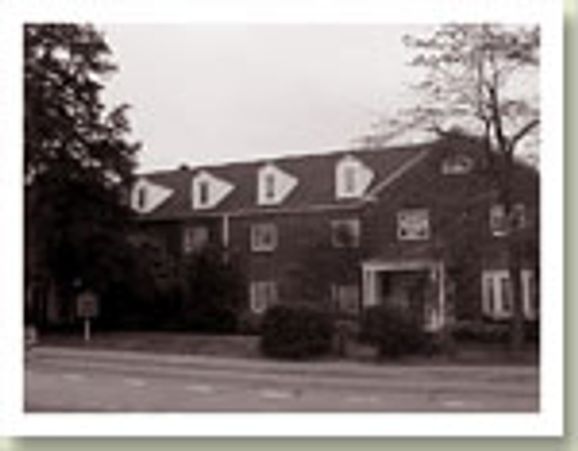
Wittle Dormitory
Marker Dedication or Erection Date: 1999
Marker Text:
Wittel Dormitory has long been admired as one of Auburn’s most significant examples of classic nineteenth-century design. Built in the early 1900’s by Samuel S. Wittel to house professional women, it also served as a home for three generations of the Wittel family. After World War II enrollment at the Polytechnic Institute, which is now Auburn University, rose dramatically and Wittel became Auburn’s first dormitory for college women. The original structure features copper roof details, wood floors throughout, silver plate applied to the front entrance ceilings and Auburn’s first elevator.
Erected by the Historic Chattahoochee Commission and the Auburn Heritage Association, 1999.

Wright's Mill
Location: Located at the entrance of Chewacla State Park, four miles south of Auburn, Alabama.
Marker Dedication or Erection Date: July 18, 1979
SIDE 1: WRIGHT’S MILL
A popular recreation area for more than 100 years. Original dam located a short distance below the Chewacla Lake Dam. Mill was located on the west bank and ground both corn and wheat. Earlier mill owners from 1840’s were Echols, Hiram Reed, Charles Nelms, and John F. Lewis. W.W. Wright (1825 – 1905) owned the mill from about 1873 into early 1900’s when it was abandoned. Most of these years his miller was Joe Broome. Just before Town Creek enters the Chewacla is the Gin-Saw Hole. A water powered gin and sawmill were located here in the 1840’s. For many years it was a very popular swimming hole.
Erected by the Historic Chattahoochee Commission and the Auburn Heritage Association, 1979.

SIDE 2: WRIGHT’S MILL
In the early 1890’s a clubhouse was built on the hill between Wright’s Mill and the Gin-Saw Hole. This was a favorite area for Auburnites before Town Creek was contaminated by Auburn Sewage. A bicycle club was formed in Auburn circa 1900. George Petrie and B. B. Ross were prominent members. A bicycle path was constructed from Auburn to Wright’s Mill. It began where Gay Street formerly terminated at Samford Avenue, following the east bank of Town Creek much of the way. Chewacla State Park was opened in 1939, and this park included the Wright’s Mill area. Erected by the Historic Chattahoochee Commission and the Auburn Heritage Association, 1979.
The Bottle

Built in 1924, and billed as "the world's largest bottle", The Bottle also known as the “Twist Inn”, was built by John F. Williams owner of the Nehi Bottling Company in Opelika, Alabama. Named for the bright orange wooden replica of a Nehi soda bottle which stood in the location for twelve years, it stood 64 feet tall, and measured 49 feet in diameter at the base, and 16 feet at the cap. The ground floor was a grocery store and service station, and the 2nd and 3rd floors were living quarters and storage. The neck of the Bottle had windows so as to be used as an observation tower. The "bottle cap" was the roof. Inside there was a spiral oak stairway. The Bottle became a gathering place for tourists and locals alike to swap yarns and have parties every Friday night on the balcony above the service station. President Franklin Delano Roosevelt stopped briefly at The Bottle after visiting Auburn. The Bottle burned one morning in the fall of 1936. Even though The Bottle structure no longer exists, the name does and is still on Alabama maps listing the area as "The Bottle."
Erected by the Auburn Heritage Association, Hayley-Redd Development and Historic Chattahoochee Commission 2015
Cullars Rotation

(Established 1911)
The Cullars Rotation is the oldest, continuous soil fertility study in the South and the second oldest cotton study in the world. It was started in 1911 by the Alabama Agricultural Experiment Station on the farm of J.A. Cullars and John P. Alvis. In 1938, the "Alvis Field" was sold to Alabama Polytechnic Institute which became Auburn University in 1960. The experiment consists of 14 soil fertility variables in three blocks that are rotated with cotton followed by a winter legume, corn followed by wheat, and soybeans planted after wheat.
National Register of Historical Places, April 19, 2003
Erected by the Historic Chattahoochee Commission and Auburn Heritage Association
2006
THE ALVIS FIELD and COTTON RUST
In the late 1800s, J.P. Alvis and J.A. Cullars farmed this property which later became known as the "Alvis Field." They allowed Prof. G.F. Atkinson, a biologist at the Agricultural and Mechanical College of Alabama, to use this site to study cotton rust, a disease that causes cotton plants to shed leaves early. Atkinson's research in 1890 led to the discovery that cotton rust was caused by a potassium deficiency. As a result, the Cullars Rotation was started in 1911. Today, potassium fertilizers are used on cotton throughout the South.
Erected by Auburn Heritage Association and Historic Chattahoochee Commission
2006
Noble Hall

Location: Located at 1433 Lee Road 97, 3 miles north of Auburn, Alabama.
Marker Dedication or Erection Date: 1988
SIDE 1: NOBLE HALLSide 1 The Greek Revival rock and mortar house was built by Addison Frazer (1809-1873) between 1852 and 1854 and served as the center for a 2,000 acre cotton plantation. Frazer owned 100 slaves and was on the Board of Trustees of Auburn Masonic Female College and East Alabama Male College. The contractor from Kentucky used slave labor to build the eight rooms with 12 foot high ceilings and 18 inch exterior walls, two cantilever balconies and eight Doric columns. In the rear are the original separate kitchen, carriage-smokehouse and overseer’s house. The Frazer family owned the house until 1922.
Erected by the Historic Chattahoochee Commission and the Lee County Historical Society, 1988.

SIDE 2: NOBLE HALLIn 1932, J. V. Brown, Head of Buildings and Grounds at Alabama Polytechnic Institute, now Auburn University, bought the house and began restoration. In 1941, he sold it and 251 acres to Dr. Luther Noble Duncan (1875-1947), who served as president of A.P.I. (1935-1947). In 1943 his daughter, Elizabeth Pearson (Mrs. Allen M.), and family occupied the house and continued restoration. Mrs. Pearson inherited the house in 1951, collected its furnishings and named it Nobel Hall. In 1972 it was the first building in Lee County to be listed on the National Register of Historic Places.
Erected by the Historic Chattahoochee Commission and the Lee County Historical Society, 1988
Chewacla State Park

Under President Franklin D. Roosevelt’s New Deal (1933-1942), the Civilian Conservation Corps (CCC) was established to provide work for single young men. The CCC’s Company 4448, Camp Alabama SP-12, began work in September 1935 to construct Chewacla Park. By March 1941, they had built a dam and 26-acre lake, roads, trails, cabins, bathhouse, manager’s house, arch bridge, and office. Barracks, mess hall, and canteen were also built on site to house the men who were from Alabama and other Southern states.
Erected by the Historic Chattahoochee Commission and Auburn Heritage Association
2009

Company 4447, Camp SCS-9, was located in Lee County about one mile south of Auburn. Company 4447 did soil conservation work on farms, controlled highway erosion, and assisted Company 4448 with quarrying stone for the new park. These camps were in District H, headquartered in Fort Benning, Georgia. Vocational and educational opportunities were made available to enrollees of the CCC program. The park was turned over to the State of Alabama, with the creation of the Alabama State Park System in 1939, and CCC work continued through 1941.
Erected by the Historic Chattahoochee Commission and Auburn Heritage Association
2009

Max Adam Morris Drill Field
Max Adams Morris b. December 7, 1918 of Blountsville, Alabama, entered Alabama
Polytechnic Institute (API) in 1938, was a varsity football player and became a member
of “A” club, Scabbard & Blade, and Blue Key honor societies. In July 1941, while attending ROTC camp at Fort Benning, Georgia, Morris rescued Wayne B. Nelson, Jr., and attempted to rescue H. Daughtry Perritt, API cadets, from electrocution. For that act, Morris was awarded the Carnegie Medal for heroism. He graduated in 1942, was commissioned a second lieutenant, promoted to major and awarded the Bronze Star
and Army Commendation Ribbon during WWII. During the Korean War, Major Morris served in the 57th Field Artillery Battalion, 7th Infantry Div. He was killed in action at the Chosin Reservoir in North Korea on November 28, 1950. His remains have not yet been recovered.
Erected by the Historic Chattahoochee Commission and Auburn Heritage Association

The original Max Adams Morris Drill Field was dedicated on May 14, 1953, by API President Ralph Draughon and located at the intersection of Wire Road, Thach and Magnolia Avenues. Max Morris Field was dedicated as a tribute to those men and women of the Armed Forces who gave their lives in the defense of this country and as a tribute to the courage of Auburn students in their determination to preserve the freedom and ideals for which generations of Americans have sacrificed so much. For many years, Max Morris Field served as both ROTC drill field and intramural sports activities.This drill field in front of William Nichols Center is rededicated as the Max A. Morris Drill
Field, a tribute to Major Morris and the above mentioned ideals.
Erected by the Historic Chattahoochee Commission and Auburn Heritage Association 2012

ST. LUKE CHRISTIAN METHODIST EPICOPAL CHURCH
The earliest members of St. Luke Christian Methodist Episcopal (CME)
Church were African American slaves, who during pre-Civil War worship
services sat in the balcony of the Auburn Methodist Church building
at the corner of Gay Street and Magnolia Avenue. After the Civil War,
their freedom gained, these members arranged for their own meeting
place at the area that would one day be the intersection of Donahue
Drive and Glenn Avenue. In 1872, the first deed was filed, establishing
what was then The Colored Methodist Episcopal Church South in Auburn.
In 1907 local businessmen A.J. and C.P. McElhaney donated the land
on which the first sanctuary and parsonage were built. The cornerstone
from that sanctuary dates to 1908.
2022
Erected by St. Luke Christian Methodist Episcopal Church, Auburn, Alabama, and the Auburn Heritage Association

Under the leadership of Rev. A.L. Jackson, early church trustees were S.M. Samford, W.M. Russeau, S.S. Simms, R. Matthews, Alex Moore, J. Perdue,
and W.V. Matthews. From 1959 to 1982, the membership worked to raise
the $225,000 needed to build the new 380-seat house of worship. During
the ten-month construction period, the congregation worshipped with the
Auburn A.M.E. Zion Church. Under the leadership of Rev. Matthew Trim,
the dream was finally realized with the first Worship & Dedication Services conducted on December 20, 1981. The Mortgage Burning Ceremony was
held on St. Luke’s 112th Anniversary, December 13, 1988.
2022
Erected by St. Luke Christian Methodist Episcopal Church, Auburn, Alabama, and the Auburn Heritage Association

BOTSFORD SCHOOL 1923 – 1950
The Botsford family came to the Farmville area, then Chambers County, in 1839. Later, Robert and Ida Botsford donated land for a new school. In 1923, the white wood frame structure with white siding was built. It had three classrooms: grades one through three, four and five, and six and seven. Each room had a pot-bellied stove for heat. Two of the classrooms could be joined by moving folding doors to create an auditorium. The first principal was Mrs. Elizabeth Bradley. Families attending through the early years include Bradleys, Woods, Clements and Coopers. Today, Botsford School is the Oldest Standing School Building in Lee County.
Erected by the Auburn Heritage Association, Farmville Community Club and the Historic Chattahoochee Commission
2015

Farmville Community Club
Mr. P. I. Washington offered a resolution on July 16, 1958 to form the Farmville Community Club for the purpose of promoting knowledge and establishing places of public recreation. On July 18, 1958, the Farmville Community Club was incorporated and purchased The Botsford School building and property from the State of Alabama for $500. Trustees were Milligan Earnest, Ward T. Bryant, and Louis Lyman Pittman. Mrs. A. C. Carter was Secretary. The By-Law Committee was Mrs. Mable Bryant, J. O. Helmes, and Mrs. Wilda Pittman. The Farmville Community Club continues to nurture a community of caring families involved in improving and enjoying this area of Lee County.
Erected by the Auburn Heritage Association, Farmville Community Club and
Cary Hall

Built 1940
A Memorial to Dr. Charles Allen Cary (1861-1935)
Dr. Charles Allen Cary, a native of Iowa and graduate of Iowa State in 1887, came to Auburn in 1892 and taught the first class of veterinary science at the Agricultural and Mechanical College of Alabama (now Auburn University). He has been called the Father of Veterinary Medicine in the South. In 1896, he helped to establish the first meat and milk inspection system in the United States. Named the first Alabama State Veterinarian in 1907, Dr. Cary became dean of the newly formed College of Veterinary Medicine, the first in the South, in 1907. Innovative campaigns to eradicate bovine tuberculosis, Texas tick fever, and hog cholera were just a few of Dr. Cary's accomplishments, as well as work with brucellosis. He was President of the American Veterinary Medical Association, Executive Secretary of the Alabama Veterinary Medical Association, and President of the Alabama Livestock and United States Livestock Sanitary Associations.
Erected by Auburn Heritage Association and Historic Chattahoochee Commission 2019
Dr. Cary's practical teaching methods included performing animal surgery under a campus shade oak to instruct his students. His Saturday clinics and summer institutes taught farmers about the prevention and treatment of animal diseases. When he was nominated to the Alabama Hall of Fame in 1957, it was stated Dr. Cary did more for Alabama livestock production and for the protection of the purity of food products than any other man of his time.
Dedicated to Dr. Cary in 1946, Cary Hall denotes classical revival architecture with symmetrical design indicative of academic and government buildings of the era. The recessed porch is highlighted by two round Tuscan stone columns flanked by square engaged columns, and stonework that extends upward to frame the second story window. Stone quoins define the outward edges of the building, including the gabled pavilions.
Erected by Auburn Heritage Association and Historic Chattahoochee Commission 2019
Funded by the College of Veterinary Medicine Centennial Club and the Alabama Veterinary Medical Association
Auburn First Baptist Church

Auburn First Baptist Church’s history dates to June 19, 1838. The first church structure was a log building erected on the north side of West Glenn Avenue on land donated by Judge John Harper, the Methodist founder of the town of Auburn. Land for the present location was given by Mrs. Matthew Turner. During the War Between the States, while the church building served as a hospital for sick and wounded soldiers, a tornado collapsed the roof which landed on the church pews thus sparing the lives of those inside. The Frazer family led the construction of a second building in 1866-67. In 1892, the congregation’s new building included Sunday School rooms and stained-glass windows. The present building was dedicated April 14, 1929. The Memorial Windows and the Memorial Pipe Organ were dedicated in the 1970s.
Erected by the Auburn First Baptist Church and the Auburn Heritage Association 2018

The church prospered from its pastoral and lay leadership who also had impacts beyond Auburn. Pastor Harden E. Taliaferro edited the state Baptist paper and wrote fiction as a Southwestern Humorist. Pastors A. Y. Napier and Howard Olive left for missionary work in China and the Philippines. Rev. M. W. E. Lloyd served as pastor three times for a total of eighteen years. Auburn University president’s I. T. Tichenor and Harry Philpott were ordained members, and Spright Dowell and Ralph B. Draughon served as lay leaders. The beloved team of John and Jeanette Jeffers, with music minister, Dale Peterson, provided the longest leadership. Preeminent lay leaders included Leland Cooper (the university’s first Baptist Student Union director and the church’s first woman deacon); Patrick Mell, C. E. Little and L. M. Ware
THE USDA REGIONAL LABORATORY FOR ANIMAL DISEASE RESEARCH
On this site in 1939, the Regional Laboratory for Animal Disease Research (RLADR) was established at Alabama Polytechnic Institute (API) during Dr. Luther Noble Duncan's presidency. The US Congress Act of 1935 (PL 74-182) called for the establishment of agricultural research labs in regions throughout the US. Each lab was to investigate agricultural problems associated with each region. Sites selected were in AL, NY, PA, SC, MI, ID, IL, CA, and MD. API researchers chose parasitic and infectious diseases of domestic animals of the southern states for research emphasis. API donated 40 acres, centered here, adjacent to its College of Veterinary Medicine for the RLADR complex. Construction began in 1937 and included a main lab building, two buildings for small animals, autopsy room, cattle barn, horse barn, isolation barns for cattle, facilities for dogs and cats, and shower/dressing room area for workers.

B.T. Simms, DVM (API, 1911), supervised a staff of 11 veterinarians and parasitologists. A governing board from 13 southern states (AL, AR, FL, GA, KY, LA, MS, NC, OK, SC, TN, TX, and VA), selected by the Bureau of Animal Industry, oversaw the research mission of the RLADR. Initial studies focused on bovine coccidiosis, internal parasites of cattle, and Johne's disease. The first publication from the RLADR described a coccidian parasite of calves, aptly named Eimeria auburnensis. The SDA's RLADR closed at this site in 1971 when a modern USDA facility was opened next to the College of Veterinary Medicine, relocated one mile to the west. The older facility continued to be used by the university as a biological research facility until the entire complex was razed in 2007.
Erected by the Auburn Heritage Association, Auburn University College of Veterinary Medicine, and Alabama Veterinary Medical Association
AUBURN UNIVERSITY COLLEGE OF VETERINARY MEDICINE

Veterinary Science began at the Agricultural and Mechanical College, now Auburn University, in 1892 with the arrival of Dr. Charles Allen Cary. By 1907, Cary had built the program to a degree-granting school, and in 1922 the program began moving west of main campus, as Alabama Polytechnic Institute expanded enrollment and programs. In 1957, API bought R. E. Hudson’s 373-acre farm on Wire Road, named for the telegraph line along the route. By 1960, Veterinary Medicine moved its large animal program from main campus to this location, and in 1970 the small animal program, basic sciences, and administration moved here. Large animal medicine was first housed in McAdory Hall; small animal medicine in Hoerlein Hall; and basic sciences, administration, and Cary Veterinary Library in Greene Hall. A small animal disease program, Scott-Ritchey Research Center, began within the complex in 1984.

In 1987, the college built Overton Auditorium/Rudd Student Center, which was expanded with more classrooms in 2014. McAdory Hall was replaced in 2003 by the J. T. Vaughan Large Animal Teaching Hospital and razed in 2012. Hoerlein Hall was repurposed, with the Bailey Small Animal Teaching Hospital opening in 2013. The seventh-oldest veterinary college in the U.S., Auburn’s college is the oldest in the South. At one time, it contracted to enroll students from Florida, Mississippi, Louisiana, Tennessee, Kentucky, Georgia, North Carolina and West Virginia through the Southern Regional Education Board agreement. Many of those states opened veterinary schools with Auburn’s assistance. Kentucky has continued its contract since 1951. Auburn’s veterinary enrollment is about one-third in each class for residents of Alabama and Kentucky and one-third for at-large states.
Erected by Auburn University -College of Veterinary Medicine, Alabama Veterinary Medical Association and Auburn Heritage Association
2023